GAME REVIEW: REDGUARD
This game is great, too bad it sucks

As far as video games go, we think of The Elder Scrolls as being pretty straightforward as a series. You know, the games are in chronological order within the universe's timeline, they're all the same type of game, the titles include the number and there's no trick about it. ✽︎ They go like TES 1 Arena and TES 2 Daggerfall followed by TES 3 Morrowind, TES 4 Oblivion, TES 5 Skyrim, TES 5 Skyrim, TES 5 Skyrim, and TES 5 Skyrim.
So we were surprised to learn that there ever was such a thing as an Elder Scrolls spin-off, and made by the same team as the main games no less. Intriguing. What is this? And why have we not heard of it?
Redguard came out in 1998, between the releases of Daggerfall (1996) and Morrowind (2002). Unusually for The Elder Scrolls series, its story takes place before any of the main series entries, making it a prequel. Its full title is The Elder Scrolls Adventures: Redguard, because The Elder Scrolls Adventures was supposed to be a whole spin-off series and this would be just one chapter, but in the end, the series part never happened, and so Redguard remains a standalone spinoff game and the totality of the Adventures series. ✽︎
We read the beginning of the article on the Unofficial Elder Scrolls Pages (UESP) about this game, and we thought it sounds interesting:
The Elder Scrolls Adventures: Redguard is the second spin-off game in The Elder Scrolls franchise, set on the island of Stros M'Kai in the Redguard homeland of Hammerfell. In the last days of the Second Era, in the wake of Prince A'tor's defeat and the Imperial occupation of Hammerfell, the mercenary Cyrus returns to his homeland in search of his missing sister Iszara who has disappeared under mysterious circumstances.
Unlike the games of the main Elder Scrolls series, Redguard is a third-person action-adventure with a predefined hero, a singular story focus, and gameplay involving platform and puzzle elements. Taking place on a single island and with a small number of characters, there was an emphasis on detail, such as in the 3D graphics and fully-voiced dialogue.
Alright! How do we go about playing it?
The installation
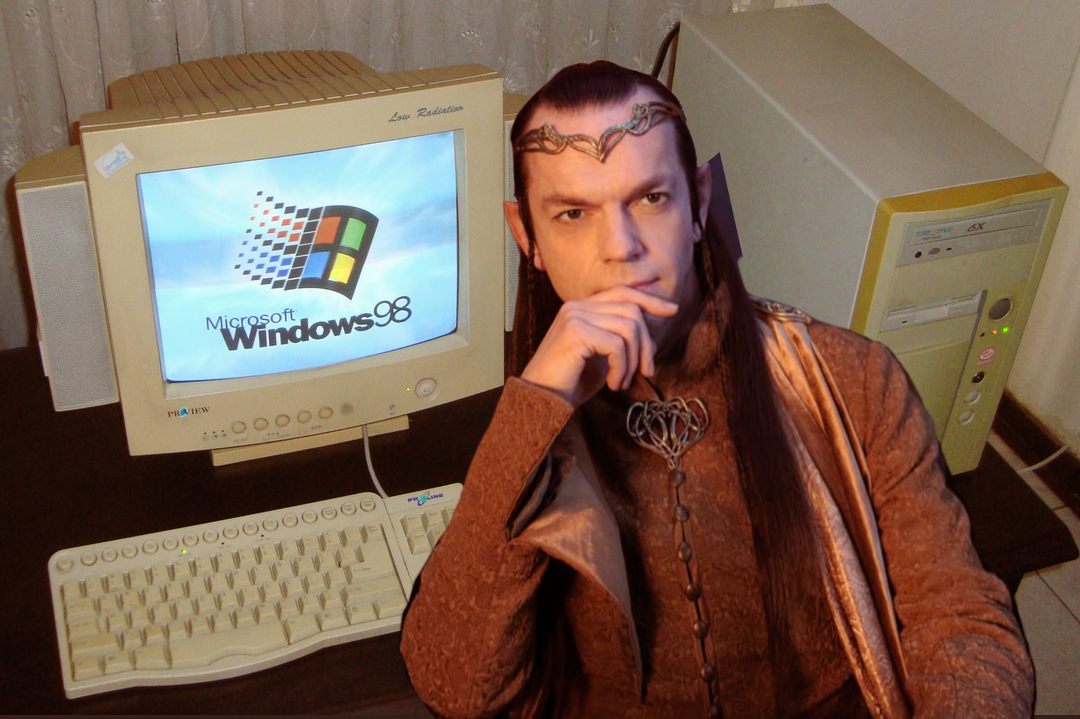
Oh, wait, it's a PC game from 1998. That's going to pose a problem. That was during that awkward moment in the evolution of home computing when we needed to know how to use both DOS and Windows to interact with the system, and installing a video game would take a whole afternoon of installation involving having to free disk space on the hard drive, exchanging multiple install discs, watching a loading bar move from 65% to 66% in the span of a whole hour, the computer is getting to the point of being practically a loud space heater, and, don't forget, we gotta correctly configure the sound card (oh god, the sound card), and maybe in the end we keep getting some esoteric error message because one of the computer's components is not compatible with this game, or we didn't realize we didn't have enough RAM, and after banging our heads against the keyboard for awhile (clack clack clack clack clack), we give up and return the game to the store, and even the employee at the store says, ah, yeah, I see, I understand, that sucks. We were there, Gandalf, 3000 years ago.
And yes, even more than 25 years later, the installation process has remained just as complicated. Well, not exactly; disk space is no longer an issue, having upgraded from a 1.96 GB hard drive to almost 1 TB, one order of magnitude bigger (the future!), but there is now the added complication of emulating DOS. Yes, setting up Redguard still requires a PhD in oldgame, and now an additional PhD in DOS emulators.

Nowadays, we could buy Redguard on Steam or GOG (which are two different versions of the game, but hold that thought), and, in theory, they would already be all configured to take care of all that headache for us, but that's six euro dollar bucks for a prepackaged version of DOSbox with a pre-set configuration file that might not even actually work for our particular system. That's highway robbery. For six euro dollar bucks, we want Todd Howard to come visit us personally and (fail to) install the game for us. So we opted to take the time to figure it out for ourselves for free. We were there 3000 years ago, and we might as well still be here 3000 years later. Plus doing it ourselves would give us access to both versions of the game, so we could have flexibility in that choice and potentially try both.
The two different versions of the game only differ in terms of graphics. Redguard can be installed to be played with either software-rendered graphics, or it could be installed to be played with "Glide 3D acceleration" which would have been, at the time, cutting-edge graphics technology. You are offered this choice because not all computers back then would have supported Glide. But the two versions look pretty different from each other and have different artistic direction. You can read all about the nitty-gritty details on the UESP. The version offered on Steam is already locked-in with the software-rendered graphics, and the version offered by GOG is already locked-in with Glide.

One complication of installing Redguard is that, while the game runs in DOS, the installer needs to be run in Windows, but that's just so that the installer can extract the files from the CD and put them into a folder that will then be accessed through DOS. So we had to mount the CD in Windows only to do the install process. As of 2025, this is still possible in Windows 11, which is frankly incredible at this point.

It was cute to see the installer. This game is from back when the installation process was an Experience, so in the meanwhile that we would have been spending hours waiting for this to be done, it would show us some concept art and play a little music, it even has some voice clips of the characters, and seeing this all is just very nice and nostalgic for us.
And don't worry about the installer's step about setting up the sound card (oh god, the sound card), that will be handled in the DOS emulator later.
When we first started playing Redguard, we used a computer running DOSBox 0.74-3, which is the latest version of DOSBox, even though it is over five years old. ✽︎ This setup was working great for us... until that computer died. We got a new computer, and we set up DOSBox in the exact same way, but it would just crash the moment we tried to play Redguard again. From what we were able to figure out, the problem seems to be because the Nvidia driver dropped support for something between the graphics card of the old computer and the graphics card of the new computer, and without DOSBox updated to handle that, this configuration won't work on the new computer. Rats.
There have been multiple forks of DOSBox in the meanwhile that have made various updates to it, including a fix for this Nvidia issue, but, in our experience, none of these forks are as solid as the original DOSBox for some reason. We were able to get Redguard to start in the various different forks, but each would have a different new problem. With DOSBox-Staging, the sound glitches and chokes, with DOSBox-X, the audio is fine, but the framerate is unplayably shit. We fussed with various settings and wound up with every loading screen taking a million years (relive the past! no, not that past!).
We ultimately struck a balance by configuring DOSBox-Staging to have reasonable visuals and load times, and simply turned off the unbearably skipping music. Sad, we like the music, but this let us play through the end of the game.
So, we recommend using good old DOSBox 0.74-3 if your computer can, but if not, see if DOSBox-Staging will work for you. (Click to reveal additional configuration notes)
- Redguard will need more memory than the default:
- Set the DOSBox (or fork) config file to have
memsize=63
- Set the DOSBox (or fork) config file to have
- You might need to alter the cycle limit:
- We found that
cycles=max limit 50000ran way too slow. We didn't actually jot down our final answer, but the necessary limit probably changes system to system anyway, so do try altering this. - Before the first time you play, you need to configure the sound for DOS:
- run
setsoundfrom the Redguard sound folder. - Choose "Select and configure MIDI music driver"; choose the option that begins with "General MIDI" and then choose configure automatically.
- Choose "Select and configure digital audio driver"; choose "Creative Labs SoundBlaster 16, AWE32 or AWE64" and then choose configure automatically.
- Choose "Done".
- The UESP has a very nice and helpful page about setting up Redguard and other Elder Scrolls games in DOSBox, which may help you work through any issues that happen to you but not us, heh.
Also, in case you encounter the Redguard door bug, where the game crashes upon exiting a certain door (it can happen to any door), there is a workaround to fix it without having to lose your progress! (Click to reveal workaround steps)
- We quit the game and DOSBox, and then, in Windows, we went into the Redguard game folder, into the sound folder, and renamed DIG.INI to potato.INI.
- We then relaunched DOSBox and reopened the game (there will be no sound effects), had Cyrus walk out of the problematic door, and everything loaded fine.
- We made a new save file in this location.
- We quit the game, quit DOSBox, and, in Windows, renamed potato.INI back to DIG.INI
- We restarted the game (sound effects will be back) and loaded from the save file we saved from outside the door.
- We were then able to continue playing normally from there, whew!
So, with Redguard installed, our DOS emulator configured, the sound setup completed, and workarounds at the ready for common bugs, one other gotcha to remember is that, while launching the game in DOSBox, we also need to mount the second disc so that the game can have access to the music and pre-rendered cutscenes. And now we're (finally) ready to go!
By the way, all this mess we had with the computer dying halfway through means that we lost a bunch of screenshots and footage that we would have used in this article :( Most of the screenshots in this article come from either the UESP or from Vazz's Let's Play on YouTube, which incidentally is the only complete Let's Play of Redguard that we've been able to find, and we also do recommend as a way to experience this game if you don't wish to play it yourself.
Let's play Redguard! This game is great!
The game opens with a long cutscene detailing the political situation of Hammerfell as of the end of the second era, right as it's being conquered by Tiber Septim.
There was a civil war in Hammerfell between the Crowns, who supported their king and wished to fight to remain their own sovereign nation, and the Forebears, who are critical of their king and wished for Hammerfell to join the Empire. Although the Crowns won the civil war, the Forebears made a sneaky deal with Tiber Septim, which allowed the Empire to invade Hammerfell right at this vulnerable moment — and it was brutal. Even though the resistance in Hammerfell was under the leadership of the charismatic Prince A'tor, an imperial noble named Richton had A'tor assassinated, and in the aftermath, Tiber Septim claimed rule over Hammerfell.

Amid all this mess, our hero Cyrus receives word that his sister is missing, and so he's reluctantly returning to Hammerfell to try to find her.
That's an impressively ambitious plot! We are very interested.
Actually, the first time we played we didn't realize we needed to have the second disc mounted yet, so we didn't get to see this cutscene, and all of this information was revealed to us through conversation with the various characters, which was also a great way to learn bit by bit and be amazed by how detailed the plot turned out to be. So don't worry about memorizing the facts from the initial cutscene, the political situation and all its intricacies will be discussed more gradually over the course of the game.

After the opening, Cyrus's boat is attacked by pirates calling themselves the Restless League. Our first gameplay task is to fight the pirates, which we achieve by keysmashing around wildly.
After this swordfight, the boat is docked in Stros M'Kai, and Cyrus goes ashore to ask around town, to any person he possibly can, "Have you seen my sister Iszara?", which will practically become his catchphrase for how often he has to ask this question.
So now we're spending several hours just talking to the townsfolk to gather information. Everyone has a million billion lines of dialogue, all voice acted wildly above 1998 video game voice acting standards. We're learning the plot and the whole conspiracy going on, and the whole complicated politics, and every random person we find in town has different complex opinions about the situation, and even what appear to be bit NPCs are fully written characters with distinct voices and personalities. This is awesome.
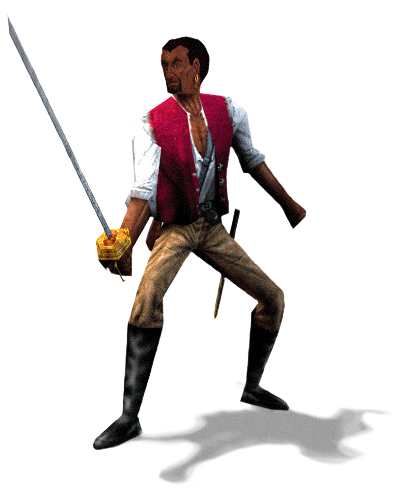
We really like Cyrus. He's cool, and we enjoy having a protagonist with a definite personality and sense of humor. Cyrus is polite and respectful, but doesn't hold back from speaking his mind and calling people out on their bullshit - which has interesting results in this very politically charged climate.
We also appreciate that Cyrus isn't one of those protagonists who starts as a blank slate - far from being a newcomer to the world, he's over 30 and well-traveled, and knows a lot of things that the player doesn't know yet. A lot of information about the story and the world comes out in conversations where Cyrus comments on the current events and such, and we can piece together what they're talking about without it being an infodump.

Like with the long conversation with Cyrus's old friend Tobias, in which, while discussing the current situation, they refer to their previous adventures together, and sometimes they throw in their in-jokes, and sometimes even the barkeep Dreekius overhears and chimes in, and it's the first time we're meeting these characters and we don't know the particulars of what they're talking about, yet we understand and we can follow what they're saying, and actually it feels like we've been knowing these characters for ages. This game has really high-quality writing, to be able to pull this off.
As we leave the bar, we remember that we read that Redguard would be an action-adventure game without even RPG elements, featuring platforming and puzzle-solving. Huh. Is it? So far it's been more like a visual novel in 3D space. Given that we're starting to put together an inventory of knick-knacks, maybe later it'll be like a point-and-click adventure game? Which is great, just, we wouldn't call this a platformer or an action adventure game...
(Evil laughter in the distance)

We talk with enough people that we begin collecting a pending quest log. Cyrus's main goal is to find his sister Iszara, and we learn that she vanished at about the same time that a priest of Arkay, Brother Kithral, also vanished. Iszara and Kithral were friends, so maybe there's a connection in their simultaneous disappearance, or maybe if we can find Kithral, he will have information to help us find Iszara.
We've received a few other quests, but this one seems definitely high priority to us, in comparison to being sent to the evil sorcerer's tower regarding an evil magical amulet, or questing for the local holy grail that Cyrus keeps hearing about, or investigating the Smuggler's Den for which we currently have no password, or trying to find the way to break into jail to check if Iszara is there, even though we don't really have a reason to really think she's there, but the jail seems like a reasonable place to check for clues at some point - we do hear that she is kind of a loose cannon, and the law around these parts is vengeful. But, alright, we think this missing priest quest is something we can do, since we even have a clue as to where to go. The priest was last seen by the waterfall...

The secret path behind the waterfall leads us to the motherfucking Goblin Caverns, full of goblins and goo and mushrooms, in a cave. It seems it's time to do some dungeon exploring and, even though right now we don't know exactly what we're looking for, let's go in and figure out why we want to explore this cave.

But the truth is, we really don't want to explore this cave. As in, we, playing this game, do not want this.
This is where we realize what they meant by action adventure platformer, and why this game is not wildly recommended as an overlooked gem. In fact, before playing, we glanced at a review on Steam that said something about how this game is enjoyable, it has amazing writing, but it can't in good conscience be recommended to another person. Well, we understand now, and we are of the same opinion, unfortunately.
In other words, Redguard is an amazing point-and-click adventure visual-novel kind of game. And an absolutely atrocious action adventure platformer. And the two of them are sewn together, and you can't really do one without the other.
Let's play Redguard! This game is terrible!
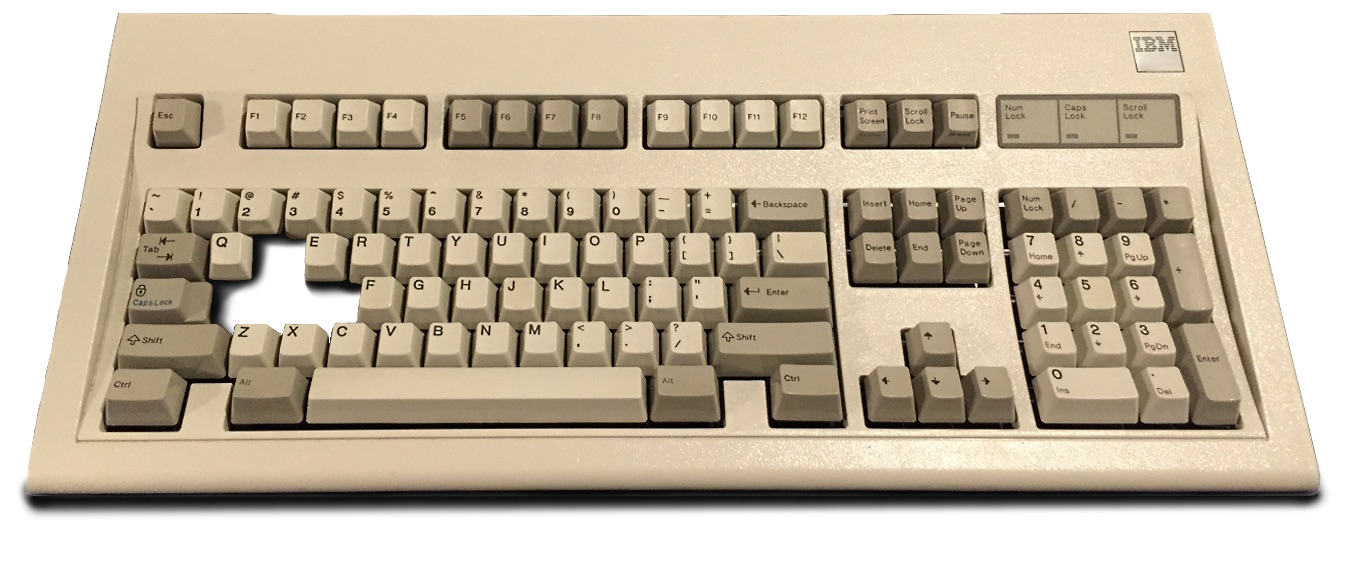
The first problem is the controls. The year is 1998, and controls for 3D games are still a wild west. WASD had not been invented yet, 3D games were still quite new, the standards for how to navigate 3D space hadn't solidified yet, and even though there was starting to be some seminal examples of how to do it right — Super Mario 64 (1996) had already come out, Quake (1996) had already come out — but they were still fresh, and it's not like those games were released and everyone immediately said, alright everyone, stop making other control schemes, these are the final stuff! It was early enough that everyone was still experimenting with different key combinations and camera behaviors.
So, Redguard is entirely controlled with the keyboard, and there are no mouse controls. To move Cyrus in the world, it's the up and down arrow keys for him to step forwards or backwards. The left and right arrows spin Cyrus like a kebab, rotating left or right. Nowadays, the left and right keys are more typically for strafing, and at first we assumed that Cyrus couldn't strafe, but actually he can: if we hold down Shift and then press the left or right arrow keys, Cyrus will take a sidestep to the left or the right.
In Redguard, the camera is not separately controlled like in other similar games of the era ✽︎, but rather it sort of follows the left and right arrow keys as we spin Cyrus, and the camera tries to find a position by itself. If we hold ALT and use the arrow keys, we can spin the camera, but while we're in this mode, we cannot move Cyrus, and when we let go of ALT, the camera goes back to where it had originally decided it was going to be. We first found this function when we needed to jump down, and we realized that there was no obvious way to look down as part of the moving controls, and we went and downloaded a pdf of the manual to figure out what to do. So yeah, there is this whole other mode that lets us freely move the camera so that we can look down to plan a jump down, but even like this, we can't look down while we jump, so we have to sort of look, remember what we saw, and jump while hoping we're right.

Given that we cannot look downwards to aim while Cyrus jumps down, we would imagine a game so designed would have very little and very easy jumping down, if any. Yet, in this dungeon alone, there are several parts in which we are expected not only to jump down a lot, but to jump down onto a tiny mushroom surrounded by instakill goo, and then bounce onto the next similarly tiny mushroom, for several jumps. There's even a part where we have to jump onto a moving target! And we can't look while we leap! And this is not supposed to be a special difficult challenge for an extra present, this is just something we have to do to proceed in the game, and the game presents it like it's easy. This game expects us to do pretty complicated platforming while functionally blindfolded, and with some of the most rudimentary 3D controls that ever existed.
Complicating matters even further, the camera not only does not help plan the complicated platforming, but it also has no idea what to do in tight spaces, where it rams against the walls brutally, causing all sorts of flashing and flickering.
So, to play this action platforming part of the game, we start getting into this weird unnatural routine of: stop everything, place Cyrus in an open enough area, look around, then walk a little, making sure to always be in the most open area possible, then stop again, look around... But sometimes we have to get through some tight spots, and there we just gotta deal.
And, just so we're clear, it's not like when we can wrangle the controls, things are easy. The controls are so unresponsive, it makes us look like we're completely incompetent and never played a video game before. Sometimes if we tap once on the forward key, Cyrus takes three steps and falls to his death off the cliff. Sometimes we're pounding on the forward key to do a running jump, and he just kind of stops. Sometimes Cyrus can climb up a box, but it seems to be dependent on which side of the box we approached, even though all sides of the box look the same. The jumping is absolutely weird: we can steer the jump after having initiated the jump, but it looks like we can only do so during certain... phases... of the jump. Jumping and then pressing forward sometimes results in a way longer jump than we'd expect, but pressing forward and then jumping (for what is typically a run jump) results in a way shorter jump than we'd expect. Also, it often fails, resulting in Cyrus just falling vertically to his death. How many times have we heard the AAA! dying noise?

And by the way, Cyrus looks like a total hunk. He's in good shape! He's got an ass to die for and legs for miles. He can lift himself up with just his hands and hang onto a ledge, drop down, and land on his hands on another ledge, Prince of Persia style. He should be well equipped to jump a decent distance, but these controls deny him this skill. We're playing as a hunk who somehow fails at jumping.
Also, this was relatively early in the discipline of level design. Later games figured out techniques to subtly cue to the player which way is an intended path and which way is merely decoration. In fact, we can complain that certain games pushed this concept way too far to make exploration mindless. But Redguard is definitely on the opposite side of the scale. We never know where we're intended to go, because nothing is stopping us from going anywhere, even places that we're not supposed to access. And since every jump in this game is hard, we don't get a cue from the feeling of impossibility that we're going the wrong way.
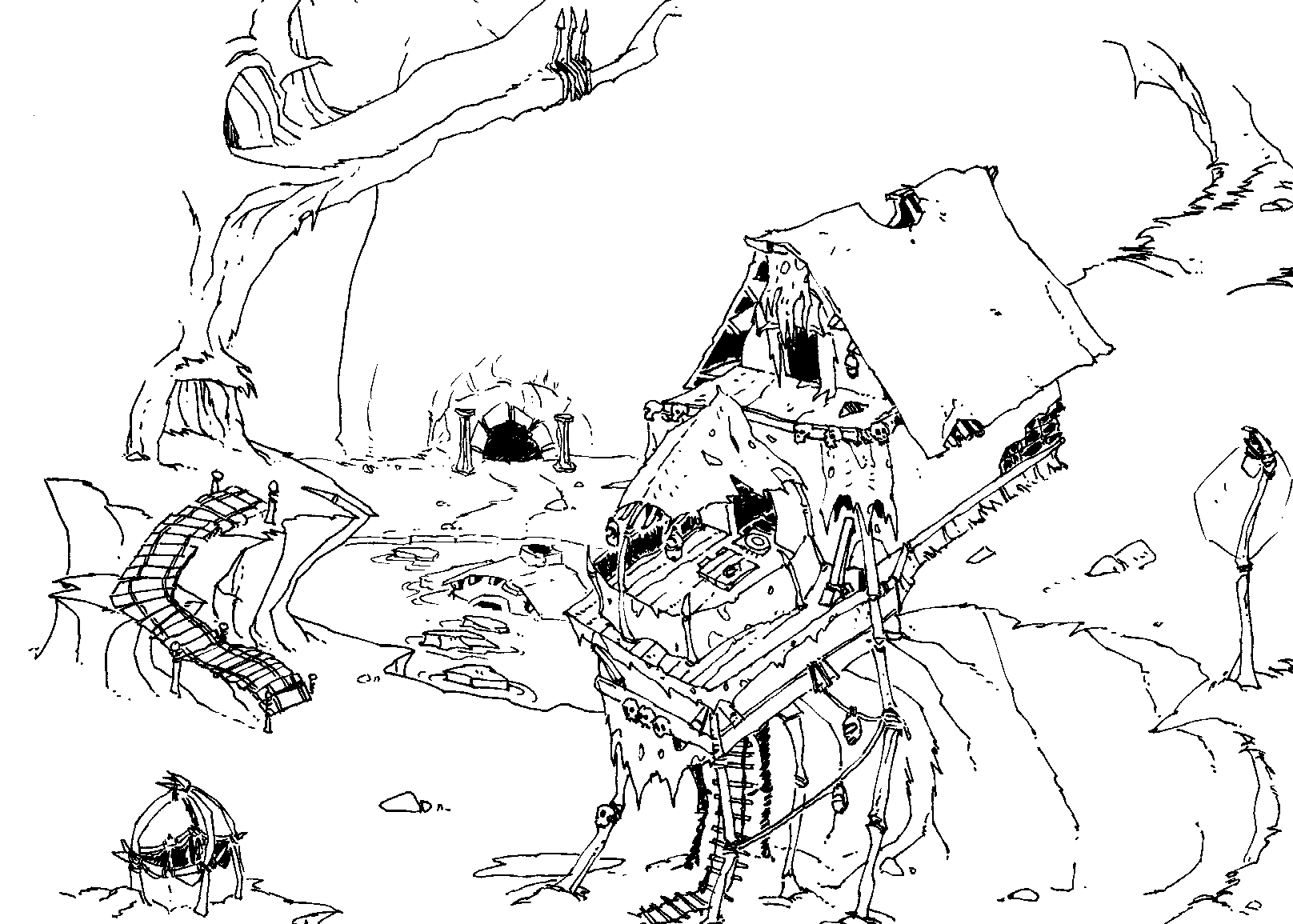
One time, we spent an ungodly amount of time trying to reach the third floor of this house floating in the goblin goo. The second floor was empty except for a box on the floor to stand on, conveniently below the opening in the ceiling to the floor above. In a video game, this is usually blinking lights for: go that way! There's something cool up there! It might even just be the mandatory path. So we struggled, and finally we managed to get Cyrus to do a jump of three inches off the ground, a jump to a ledge that he could have reached if he had stretched his hands above his head, but this was so difficult. So, what was up there? Nothing, actually. We weren't supposed to go that way. It's a dead end and no items were there. It was decorative.
Another time, we thought we had to inch around a pool of goo and find a way to drop down safely to where we could see goblins prowling below. Because the goblins are there, we think this is definitely a place for us to visit. It is, but it's actually not accessed from above, but from a path below that will be mandatory much later. If we had no previous saves and saved where we had gotten ourselves, we would have been stuck forever in this spot from which we can't jump back up from and can't survive the drop down from. Multiple saves. This is a game in which you need multiple saves.
Though, not too many saves. We read that someone encountered a bug when they had too many saves that made the game unplayable, and they needed to manually go into the game files and carefully delete some in order to continue the game. It sounds like they had a few hundred saves though, and while with this game we completely understand how that happened, unfortunately, we can't do that. So, yes, we want multiple saves, but not too many that the game can't handle.
The kindest feature of this game regarding the platforming areas is its extremely forgiving save system, in fact. We can save anywhere at any time, and we can name the save files for our convenience, and when Cyrus dies, the game immediately prompts us if we would like to load from our most recent save, and we can get back immediately without any cutscene or extra screens, and immediately try again. A feature which we recommend using as widely as possible. We should probably save after like essentially every jump.
So we realized this was the way to do things in this game. We saved more and more frequently as we got deeper in the dungeon. We keep one save from before the dungeon just in case we go the wrong way and wind up in an unrecoverable situation, a few saves inside the dungeon, and we overwrite one or the other rotating savefiles after each and every jump, once we have confirmed that we're doing something possible and going the right way.
Because, we talked about some of the wrong jumps we were trying, but, in this game, pretty much any mandatory random jump might require no less than 50 attempts. At least we can reload fast and try again. And we try. Oh my god, do we try...

All these issues make the dungeon crawling aspect of this game a grueling and miserable experience, but it's not like the dungeons themselves are necessarily bad. In fact, we really like the other elements of the level design. The places we are seeing and things we have to do to navigate dungeons are varied and interesting. The Goblin Caverns have bouncy mushrooms, exploding mushrooms, goo, dams, water wheels, teleporters, a giant fish, trolls, cages, a bone key, a shipwreck full of TNT, and a half-fallen house in the goop. If we could actually do a jump with any competence, exploring this place would be fun. It made us almost long for a faithful remake in an engine with functioning controls, because that's really the only limitation. It could be exactly the same, just with jumps that work.
We've split this article in multiple parts for ease of navigation. This Part 1 is a relatively spoiler-free introduction that we think gives enough information for someone to decide of they want to play it for themselves and how. Continuing with Part 2, we discuss our particular experience during our playthrough of Redguard and our thoughts and reactions about what happens. We will openly spoil major plotpoints, so you can decide if you'd like to continue reading or not.
- Part 1
- Part 2
Notes
-
Borderlands 3 is the fourth main entry of the Borderlands series and the fifth game in the storyline.
Kingdom Hearts 3 is the twelfth game in the Kingdom Hearts series.
...Sentences for the completely deranged.
- Similarly to how Battlespire (1997) wound up being the only entry in what was supposed to be a whole series of An Elder Scrolls Legend games.
- It sounds like lots of life has happened to the main developer, but the project is not abandoned. Don't worry, we understand.
- Like in Super Mario 64 (1996), Tomb Raider (1996), Rayman 2 (1999)...