GAME REVIEW: NI NO KUNI
So pretty, and yet...
Please know that this page is going to be full of unmarked spoilers for Ni no Kuni: Wrath of the White Witch, so, if you don't want spoilers, don't read this page.
This is part 2 out of our 3-part review of Ni no Kuni: Wrath of the White Witch.
Hand-holding and berating

Usually, in games, when you're given the ability to quick-travel around, it's like the game is giving you the keys and trusting you to know what you're doing. Normally, at this point, you're way past the tutorial mode. And so it seems to be in Ni no Kuni, considering that now we have a full party, many familiars, a whole library of spells, and access to several virtues. Yet, somehow, whenever we have to decide to do something, the game keeps giving us the answer to everything through Drippy, and not because we asked. And he has to berate you in the process of giving you this answer you never wanted!
When Drippy first meets Oliver, Oliver is understandably confused, and asks a lot of questions that Drippy perceives as being dense. Because of this, Drippy is very condescending and insulting to Oliver as he serves the function of tutorial fairy. While this treatment might make sense during the early part of the plot, Drippy does not let up on Oliver one iota during the course of the game. Even after everyone is supposedly friends, and after Oliver has established himself as a skillful wizard, and after all swearing to look out for each other... Drippy is still constantly nasty and condescending to Oliver. Even when complimenting Oliver, he needs to somehow make it backhanded or insulting. Like, "Come on, Oliver, make with the magic, mun! You think the spells are going to cast themselves?"
For a specific example, we got to one part of the game where there wasn't enough light to see. So, we used the "Magic Lamp" spell to have Oliver light the way. After we had done this and taken a few steps, then Drippy popped up all, "Hey, Oliver, don't you think it is dark in here? You should use your magic to create light! Geez, do I have to tell you everything?" Thanks Drippy.

This condescending hand-holding is especially bad with the virtue mechanic.
Virtues are shallow
As we said before, the different broken-hearted characters are depressed and are unable to get themselves out of bed, or to have positive interactions with others, or to take proper care of themselves, or to have a sense of self-worth. The main plot of the game has Oliver dealing with grief, and then there is this mechanic of him helping others cope with depression. This is a treasure trove of possibilities for really deep and touching plotpoints, and it seems like the game would practically write itself and make Denise start crying every few minutes... but, alas, for how beautiful this should be, instead, somehow, pretty much all instances involving helping someone who is heartbroken are really... shallow.

Last year's champion is nervous that they are going to lose a tournament, and so they need a jolt of confidence. Someone was cranky toward their friend, and so they need a refill of kindness. Someone has been a bit meh about going to work this morning, and so they need a burst of enthusiasm. Someone has been splurging on sweets, and so needs a whack of restraint. Someone isn't sure if their childhood dream is actually the right career path for them anymore, and so they must get a helping of ambition. All this is really obvious and uninteresting, but even worse, rather than doing something poignant and meaningful by addressing the impact of depression on someone's life and how to work toward healing, the game seems more about demonizing being anything less than 100% positive and cheerful and glad to be doing your duty at all times. Poo. And we must make a particular point of how sick we are of the rhetoric of never being allowed to let go of your childhood dreams, even if you yourself are deciding that they no longer match your current dreams. Double poo.
In any case, every single time you encounter someone who is heartbroken, Drippy is going to tell you exactly which virtue has been stolen and needs to be replaced. We thought maybe the game was being super hand-holdy for the tutorial, but no, this will continue to happen every - single - time. We walk up to someone who says something like, "I am too afraid to continue with my business because I am too scared." Drippy feels the need to explain that this person is definitely heartbroken and definitely needs some courage. Really. No shit, Drippy.

Now, it is nice for the game to not necessarily leave us stumped. Some of the virtues are not quite so clearly differentiated from each other, and maybe some of the scenarios might have had us thinking the answer was courage when it really was enthusiasm or confidence. But here's the thing. We've never even had a chance to be confused because Drippy tells us the answer every single time as soon as we encounter anyone who is heartbroken. And even if we did somehow mess up, the game won't let you use anything but the proper virtue to mend a broken heart. There's no penalty even if we were temporarily confused.
Rather than having Drippy force-feed us the answer, why couldn't it be, if we ever find ourselves confused between kindness and love, we could then choose to talk to Drippy, and Drippy can ask us if we want his advice or whatever, and if we say yes, then Drippy can tell us this person actually needs courage. But give us some respect of having half a brain cell. It already uses incredibly obvious keywords like "afraid" and "scared" to signal that the right answer is courage. Why must the game then immediately give us the answer like this?
Another interesting idea that somehow didn't go anywhere meaningful is the flipside of being heartbroken. Some people have too much of a virtue, and it is explained that this condition is also harmful. That's why we don't need to feel bad about using the Take Heart spell to siphon off the extra virtue from one person and then using the Give Heart spell to replenish someone who is brokenhearted. However, the game tackles this idea of someone suffering from too much virtue very rarely. There was someone with so much restraint that they were starving themselves in order to dedicate themselves further to their research, and someone with so much courage that they were putting their life in danger for the sake of daring feats. But otherwise, being overflowing with virtue is never really shown as being bad; it is usually shown as a good thing! And, just like the people who are brokenhearted, the bit of information we get about those who are overflowing with virtue is also handled very shallowly. Things like cooking dinner for the elderly indicate kindness and doing lots of aerobics indicates enthusiasm. Sigh.

Somehow, even though having too much virtue is (said to be) bad, you aren't allowed to help those with an overabundance if you are already carrying a helping of that particular virtue. Somehow, even though he gets a so-called Bottomless Bag for holding all his items, Oliver's Magical Locket cannot fit more than one helping per virtue at a time. Drippy berates you for being greedy if you try. Wait, greedy, what? We want to help these people! Why is there a limit? Just so that you have to go back and forth more times, to ensure maximum backtracking for no particular reason. Especially now that we have quick travel, it's not like backtracking is hard and we need to plan our route.
Given that the plots of all these sidequests are so shallow, and the virtue needed is hammered home well before Drippy simply announces the answer, soon there is very little joy in completing these quests. We feel like some other story would be chomping at the bit to sink its teeth into this premise, but somehow Ni No Kuni just... doesn't use the premise it set up so beautifully for itself. And that makes us very sad.
Why aren't any characters low on more than one virtue? Or low in one virtue but overflowing with another? Isn't the person who has so much courage that they keep putting themselves in danger... actually high in courage but low in restraint?
The game introduces each virtue one at a time. The developers did it right in the very first case with enthusiasm, which is good, considering that's the introduction to the entire virtue concept. However, the subsequently introduced virtues are also handled one at a time. By the end of the game, when ambition is introduced, essentially all of the suddenly unlocked sidequests feature that virtue and that virtue exclusively. You'll somehow never be seeing the virtues from the beginning of the game anymore -- when was the last time enthusiasm or restraint were involved with anything? Once the ambition side-quests are unlocked, then and only then are the NPCs all lacking in or brimming with ambition. It's not like you encounter characters along your quest that are clearly brokenhearted, but you don't have the means to help them yet. And it's not like you can see people brimming with virtues you haven't unlocked yet, so that once you unlock that virtue, you can think, aha, there was that NPC in Al Mamoon that definitely had a lot of ambition -- let's go talk with him! No, once you unlock a new virtue, only then does the whole world suddenly become themed around that one virtue.
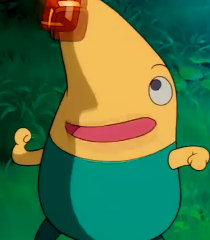
Because of this one-virtue-at-a-time approach, we never have a locket full of every virtue at the same time. It is especially unlikely that we won't try to heal the brokenhearted with the right virtue, because, of course it's confidence, Drippy, everything is confidence right now...
So, in the end, this whole lovely mechanic based around battling depression just becomes, unlock the new virtue, go back to every town you've been to before, go to the people indicated on your map as having that virtue in excess, have Drippy insultingly tell you they have lots of the new virtue, collect one helping of it, go to someone who needs help -- wonder what virtue they will need?? -- have Drippy berate you for not realizing that they are brokenhearted and in need of the new virtue, and then you give it to them, and they have their shallow problem forcibly resolved. Repeat, and repeat, and repeat... and then move on to the next new virtue. Sigh.
The fact that this could have been so good, and that they made it somehow not even fun, is just a complete tragedy.
We can't even think for ourselves in the boss battles
Drippy is going to tell you the weakness of every boss about 30 seconds into the boss fight. This is going to happen, there's no way to avoid this, so just expect it. And sigh.
On one of the early bosses, we had already figured out that the weak point was the tail, and in the middle of whacking the tail, Drippy interrupted everything to inform us that the weak point is the tail. Thanks Drippy.
Even worse, once we got to the monster in the graveyard, we were already hitting it with the Light magic spell we had been given specifically for fighting this monster, and which is clearly super effective. In the middle of using the Light spell, Drippy jumped up to tell us that we should be using the Light spell. This interruption caused the spell to be canceled. Thanks Drippy.

You can't even have fun with puzzles

One thing about this game that we noticed immediately upon opening the game case, before even starting the game for the first time, is that there is an in-game language with a made-up alphabet, and a key is provided on the back of the manual for you. This language is introduced as the language of magic, and if you look around, it's all over the magic book, around the magical circles, ooooo. We love this sort of puzzle-solving and code-breaking and depth to the world. Yay!
Then we got to a part in the plot where this language is playing a critical role. We look at a rock, and we are greeted with four lines in the rune language. We almost got up to get the manual, but this game is even better than that! It gives you a button right there to open the key in-game. Niiiiice.
So we got a paper, and we started decoding the message. We were halfway through deciphering it, but then Drippy just flat out tells us what it said. We were loving the opportunity to translate it, the game gave us the key right there, and then it just hits us with the answer!

Now, we can understand, maybe someone doesn't care, and that's nice to let them just get the answer, but this was required dialogue. Maybe it could have gone that Drippy asks if you want him to read it, and you can say yes or no. But certainly not after finally giving us something to translate, and even going so far as to give us the in-game key, it then just gives us the answer! Why?!?!
All this handholding makes us hate Drippy, and we don't want to! We want to like Drippy! But he ends up being a nasty Navi. Navi was the hated tutorial fairy that always gave you the answer back in 1998. What excuse does Ni no Kuni have for being unaware of this trope in the year 2011?
As always, flying is better than sailing
We have gone around the world, found the hideout of the air pirates (yes, there are both water pirates and air pirates in this game; we're waiting for earth pirates and fire pirates too), and helped their friendly dragon Tengri, whose soulmate had lost confidence. Now, we can call Tengri whenever we want, and he serves as our flying vehicle. Which is much faster than our boat, especially since there are no random encounters in the sky.
So yeah, the poor boat is immediately rendered obsolete by teleportation (at least for backtracking's sake) and then by riding a dragon. Why would we ever sail again once we can ride a dragon? Maybe to tame the sea familiars? To go to the few places where the dragon can't land, for whatever contrived reason? But there is otherwise zero incentive to use the boat ever again.

Maybe we're just scarred for life, but this boat and dragon thing reminded us strongly of the boat and the planes from Tales of Symphonia. In which it was equally ass and one rendered instantly obsolete by the other. Actually, even worse in some ways. The boat in Tales of Symphonia is needed to reach at least two places. The boat of Ni no Kuni is only needed to go to Hamelin (and then later to encounter the pirate ship, but that's contrived and out of nowhere and forgettable). We even do the whole thing of hiring the crew and we thought they were going to be important, but then they are not. They just get to follow us around the map for the rest of the game, paddling wildly to keep up with the dragon. So, yeah, it was even less useful than the boat from Tales of Symphonia (and we ranted about that). At least the boat in Ni no Kuni was more enjoyable to move than the Tales of Symphonia one, and looked pretty.

Anyway, now that we have a dragon on our side, we can explore the world and go anywhere, right? We spotted a few things of interest on the map, like a strange rock on Swan Island, a cave with a hermit in it, and a temple on a mountain, but in all of these cases, the game essentially told us, come back later. What good is it to suddenly be able to fly anywhere, if we can't fly around and find cool things? We haven't found a single optional place that we could actually visit. Either don't let us go there at all, or at least offer a treasure chest or something, so we can feel good for exploring, and not like we are wasting our time.
Even worse than not being able to do any of these clearly come-back-later things is the fact that we'll die immediately upon hitting any random encounters in a place where we weren't supposed to go.
Level gating
This game uses level gating like you would not believe. Whenever we first arrive in the new place where we are supposed to go, everything is hard. It's almost like we're not supposed to be there, but you can tell the difference, since if you go where you shouldn't go, you will die immediately. But no, the correct new place starts off being almost impossible. And this is after we've done every possible sidequest and battled around trying to tame the familiars that caught our interest. We don't think we are being under-leveled or anything.
Once you start surviving in a place, it then becomes easy. It's like whenever you cross whatever the threshold is, you go from attacking for 1 damage to suddenly 30 damage. By the time you are ready to leave a place, the battles are a snooze. The game essentially tells you to leave, because the monsters will be scared of you and actually run away from you and disappear from the overworld. So, you move on... until you hit the brick wall of the next place.

On the problem of accidentally finding the level gate, it would help if we could see the enemies' levels. Some times, we've found a new area and thought for a moment that maybe we need to do something else, maybe we need to send a different familiar, maybe... But we bet that we were just level 20 pitted against level 40, but you never get to see that. You never get to have the confirmation that you weren't supposed to be there, and then you just die.
And running from battle never works. Or at least, it never works when you need it, which is when you would try to run away. You've wandered into a part of the world where the enemies are stronger, and this running away mechanic seems to be level-based, so you try to run away, but you can't, and you die. And after attempting to run away, if you fail, you're stunned for a few seconds, letting your enemies get some cheap hits. This is cruel, why even have this?
And, in this game, you really don't want to die, because you'll pay for it. You can either load from your last save or pay a good chunk of in-game money to continue from where you died. You may be thinking, well, just load then, but the problem is that you can only save at save points in dungeons or when you're safe in towns, and in the meanwhile you may have tamed a familiar that had only a 3% chance of being tamed, and do you really want to go through that agony again?
But, when you die and have to pay to continue, where does the money go? Why do we need to pay a fee to continue the game? Who is it for? Drippy? Who's there happily snoozing while we're dead? For that matter, why do we get money from fighting random monsters? This is a common issue with many games, but still. Is the wildlife of this game rich? From what? Oh, from killing us and taking our money? Is that what the continue fee is for?

The continue fee, at the beginning of the game, is 100% of your money. Yikes. If you paid that to continue, you could even put yourself into an unwinnable situation! How are you supposed to continue if you can't buy more sandwiches? Especially at the beginning of the game where you don't have a good healing move yet, and can't use alchemy to craft more healing items.
But then, later, if you do any sidequests at all, it will become 10%, and then later again 5%. This game is one of the biggest offenders of the whole, when you're poor you're poor and you have to pay out the wazoo, and when you're rich the fees are mostly waived.
The spells and interacting with the overworld

At this point, we have an entire inventory of spells, many of which can be used outside of battle and are needed to progress in the game -- for example, we've needed to turn a milk fountain into cheese for the Cowlipha, for which we used Secret Ingredient, and we've needed to make mushrooms grow faster to create platforms for us, for which we used Quicken Growth. However, don't imagine that all these spells are actually useful or involved in puzzle-solving. No, you use Secret Ingredient exactly that one time, and Drippy tells you to do it. There's the dungeon where it's dark, and Drippy tells you to use Magic Lamp, and that's the only place where you even can use this spell.
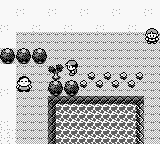
Once again, this is begging to be implemented in a smart and fun way. See for example Pokémon and the HMs. It's not like you use Surf only once to get past a single obstacle. Once you get Surf, not only can you progress to the next part of the plot, you can also backtrack to all those spots with water that have been taunting you since the beginning of the game, and you can try to use Surf there, and in most cases you'll be rewarded with something cool, like a hard-to-get Pokémon, a rare item, or even an otherwise-unreachable Trainer to fight. Instead, in Ni no Kuni, you get all these spells with effects that seem cool, that should unlock an entire new part of the game, and somehow, it all goes down to... use it once when Drippy says so, to prove that you can go past this part of the game. It might as well be a ticket in your inventory.

The few spells that you do get to use more than once are, instead, just unfun, and often even illogical worldbuilding-wise. For example, there is Spring Lock, a spell for opening blue chests. Just the blue chests. The red chests are apparently unlocked. Once you get this spell, you have to go on the menu and select this spell for every blue chest. This is annoying, and how is this any different or more exciting than just opening the unlocked red chests? Or, why doesn't Oliver just do the the spell unprompted once you try to open the blue chest? Needing to go into the menu and select it every time is just a tedious extra step.

Furthermore, Swaine has the lockpicking thief gun that opens... only green chests. He can't even use it on the unlocked red chests. Sometimes, we'd see a red chest in a position that would be tricky for the party to reach on foot, but Swaine would have a perfect line of sight and could feasibly open it with his lockpicking gun, but he won't do red chests. They don't match his clothing.
By the way, using Swaine's lockpicking gun isn't even fun. Lining up to open the green chests is hell. There's only one secret designated spot from where you can open a certain green chest, and there is no hint or logic to it at all. Good luck finding the magical place in the dungeon from which Swaine can open the chest. You think it's just a thing of bringing up his character and selecting the lockpick gun? Nooo, he has to stand in the perfect right place so that he looks super photogenic, we guess.
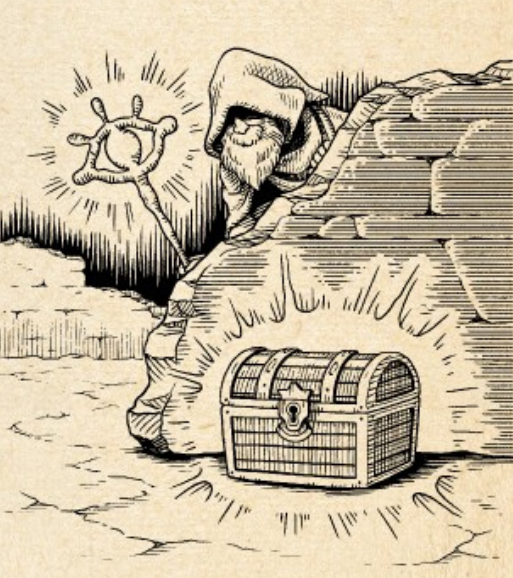
And in terms of worldbuilding, imagine this world where there are red chests all over the place that aren't even locked, and then there are blue chests all over the place that any wizard could open (just, there's no more wizards). And then there are green chests that only Swaine can open. Not even the magical lockpicking can open them; Swaine can't open the magical locks, but the wizards can't open the Swaine locks. What the hell?! Then there are purple chests that only the Mornstar can open, even though it's apparently been lost to the sands of time. Who put the purple chests there? Who locked them just for the carrier of the Mornstar, and left them in the open for anyone to see them in Ding Dong Dell? What's this, some sword in the stone bullshit? Only the chosen one can open this box, so we have to keep it tucked in a corner of the town square for all eternity... And then you can open it, and yay, there's an ancient cake in there that you can feed your poor familiars. And there's not just one of these purple chests, but many. What the hell.
Also note that treasure chests, of various colors, can be found inside stores. Actually, pretty much every store has at least one chest in it. And Oliver has no qualms whatsoever of getting an object out of a box in a store and just keeping it. You don't think that was merchandise that was for sale or anything? No one yells at Oliver for shoplifting. This is taking the video game trope of just robbing people's houses to another level yet. Here you are robbing a store.
Anyway... we also have access to a spell called Spirit Medium, which lets us talk with ghosts. Except there are like, three ghosts in the entire game.

When we first got Spirit Medium and saw that it would let us talk with ghosts, Denise got excited, because she remembered Pathways into Darkness. In that game, you get the Yellow Crystal, which lets you converse with the souls of the dead nazi corpses you find in the labyrinth. You get a whole text interface and can use free text to ask them about how they died and stuff. It was really cool.
In Ni No Kuni, there is just the Spirit Medium spell you need to cast like it's a chore to get the dialogue of the three ghosts in the game. Nothing is cool about this. It's like casting Spring Lock on the blue chests. Now you can talk to the spirits. You just have to select the spell from the menu every single time, and there you go. Just an extra step for talking. And what do they talk about? Well, one ghost wants to keep giving you SAT-style reading comprehension tests about stories found in the Wizard's Companion. Fuuun!
Besides the three ghosts, there are other undead characters in the game, but we can talk with them normally. Why don't we need to cast Spirit Medium to talk with the undead pirates or the skeletons in the graveyard? Nope, just ghosts. Just the three of them.

One of the one-time-only spells, Poison Apple, was even used in a context relating to the undead. It's a spell that Oliver uses to fake his death so he can get into the graveyard, because the guard skeleton won't let anyone who isn't dead go through. That's the only place you use this spell. Also, eating a poisoned apple to fake his death... isn't that ridiculously extreme for what we were trying to achieve? Make a child intentionally eat a poisoned apple so that he temporarily dies, just to trick this one guard to letting us into the graveyard. We couldn't just talk to the guard and convince him that Oliver is the pure-hearted one on a quest and that he must pass and we promise to leave as soon as we are done? Nope, gotta trick him with Poison Apple. And, just to be clear, yes, this is mandatory to complete the main quest of the game, and yes, Drippy tells you to do it.
Oliver also gets the spell to talk to animals. It is just as much of a chore and just as unfun as Spirit Medium. There are also dogs that you can't cast the spell on for no apparent reason, and so you only get to hear them bark. Do they have nothing to say? Do they just like barking?
Also, it's really annoying how every time you talk to a ghost it is always OMG you can hear me?! And every time you talk with an animal it is always OMG you can understand me?! And every time you ask someone if you can borrow their excess virtue, they say I dunno what you mean, but sure, if it is to help someone. It was cute the first three times, but now it has been like fifty-three times and enough already!
There's another spell that we can use multiple times in the overworld: the Bridge spell, which creates a land bridge to parts of the map that would otherwise be unreachable. That is, until you can just fly on a dragon and get to the other side. A particularly egregious example was near Ding Dong Dell, where we could make the bridge early in the game, but the monsters on the other side would be deadly as a level gate, indicating that we weren't supposed to explore on our own and have fun with this game. By when your party can withstand the monsters on the other side of the bridge, you can just fly on the dragon, so what's the point of the Bridge spell here?
Another one-time-only spell that could have been so cool was Insight, which lets you see the past of a well-loved object. Oooo!


Rosy thought it would be like in Psychonauts, when Raz gets Clairvoyance, the ability to see through the eyes of other characters. When you have Raz use this ability, you get to see the world from the other characters' vantage points, but not just that -- you also see how they see the world. So, things will be rendered completely differently, based on how their minds work. For example, depending on what they think of Raz, Raz will look completely different through their eyes. Raz needs to use this ability to see certain things to be able to progress in his journey, but apart from that, you can choose, for your own amusement, to use this ability on any NPC in the world, and each time, you will get to see something completely different. This was exciting, character-building, and fun. Rosy was expecting to be able to use Insight on many different objects in the world to learn something interesting about them and the person that loved them, and get cute Easter Eggs or optional dialogue.
While Rosy was thinking of Psychonauts, Denise's mind leapt to Ghost Trick. In that game, you replay time and manipulate objects to change what will happen when time starts again, and thereby change the future and solve mysteries. In the context of a game like that, the ability to see where and how an object used to be could lead in so many interesting directions. Perhaps this broken piece of ceramic is revealed to have previously been a plate and located in the suspect's kitchen - dundundun! Or, that this innocuous object used to be somewhere else far away, and, hm, how did it wind up here? Denise was waiting for there to be a lot of puzzles that made use of such an ability.
So what did Insight in Ni no Kuni do?
You use it once to read a map. As a mandatory event along the main plot of the game.
That's it. You can't use it anywhere else.
How did the developers of this game manage, over and over again, to set things up to be wonderful, and then just... not do it? It's starting to feel like some sort of a joke... or a disorder... clinical laziness or something. We don't get it.
By the way, all of the spells come with in-depth explanations in the Wizard's Companion. Some of these descriptions have very interesting or unsettling implications. For example, the notes about Spring Lock say that you should be careful about which locks you open and that you will be punished if you get too greedy -- we thought, probably with some sort of booby trap or maybe a powerful enemy emerging from whatever you just unlocked (Denise was expecting Ni no Kuni to reference Little Nemo: Adventures in Slumberland; Miyazaki was involved in the initial development of the movie, and the plot revolves around Nemo opening a door that really should not have been opened). But this description of the Spring Lock spell is actually just flavor text, and there is absolutely no in-game implementation of anything resembling this idea. If you were like us and read the Wizard's Companion back when Drippy first urged you to do so, you would be bracing yourself every time you open a lock, and never, ever does this threat come to fruition.

The descriptions of the spells in Ni no Kuni are full of all sorts of ideas like this one, things that made us go, oooo. We wondered what fun game mechanics would harness these ideas. But then... they never happen, and the Wizard's Companion is just full of cool ideas that could have and would have been tackled by a better game. And Drippy encourages you to read all this... so that then you can be disappointed at what this game could have been. Were the developers expecting us to do all of the legwork and imagine these things coming into play in fanfiction-land? Come on.
Another example was with the spell Quicken Growth. Despite what you might assume, the flavor text for this spell talks about how this spell works not just by happily making the plant grow. What is actually happening is that the spell is speeding up time for the plant, so that it goes through months of its lifespan within a few seconds, like a time-lapse video. The Wizard's Companion even clearly points out that doing this shortens the effective lifespan of the plant. And then, Oliver just uses it on a bunch of mushrooms just to make himself platforms to reach a higher plateau in the Golden Grove! He's there, robbing the life of these poor mushrooms, just so that he can step on them and get that secret treasure chest (which does not contain any sort of punishment for being greedy and evil)!

For all how the Wizard's Companion emphasizes using magic responsibly and always considering the consequences of your actions, Oliver and Drippy never discuss or address this at all. There are no negative repercussions for shortening the life of the mushrooms. And this seems rife for a storytelling opportunity and driving the points that (we thought) the game was trying to make. For example, Drippy could have admonished Oliver for using magic in an irresponsible way, and they could have had a discussion about that, and later the player would need to not use magic in other careless ways. Or, even more poignantly, what if we return to the Golden Grove later, and see that the mushrooms have died -- and Drippy can point out, well, yeah, they only have so long to live, and you made them use up so much of their lives. And Oliver can think a bit more about the inevitability of death, and the value of life, and reflect on the death of his own mother, which he is in the process of grieving.
But no, as far as the gameplay is concerned, just make the mushrooms grow into platforms, and isn't that cute.
Inns and cheating the economy

This game does the thing where you can stay at the inn to heal, which costs a certain amount of gold depending on how far in the game you are. The inn at Ding Dong Dell is 10 gold, but the inn in Hamelin is a whopping 140 gold. Holy shit, how does the economy of this game work?! Usually in games where the inn prices ramp like this, we just feel terrible and do everything in our power to not stay in the overpriced inn. This game, however, adds a nice perk to staying in each inn at least once: you can absorb the memories of past wizards who have stayed in this inn, which is the only way to fill in certain pages of The Wizard's Companion. We really appreciated this added justification to stay in the inn at least the one time without needing to feel guilty about it.
However, once you've stayed in the inn once, and once you get teleportation, there is then absolutely no reason not to warp back to Ding Dong Dell and stay in the inn that only charges 10 gold.
But wait, even better! Every dungeon starts with a save point that fully restores your health and magic points, for free! So, actually, don't warp to Ding Dong Dell, warp to any dungeon, step inside, heal and save, and step outside again.

The best idea is to warp to The Deep Dark Wood, heal and save at the save point, and then go tell your latest adventures to Old Father Oak, for which you will be rewarded with cute dialogue and nice items.
Similarly, you should only buy items at the store where they are the cheapest. Get your cakes and carrots at Ding Dong Dell and your milk in Al Mamoon. You'll be warping around for all the best sales.
It feels like we are cheating the game to do this sort of thing, but they are the optimal solutions, and we might have even been intended to have come up with them? Or else, it seems like the developers didn't really think out the implications of introducing teleportation to the game. On the one hand, we're glad that we have teleportation! But on the other hand, couldn't it be better somehow? Teleportation is at least quick and easy, but at this point of the game, we are just warping constantly. If every inn and every shop had the same prices, we wouldn't need to warp here and there just to get the best deal on lettuce. And there's no point in walking, since the monsters give almost no experience in old areas, and they run away anyway. There is a spell that lets you find invisible treasure in the overworld, so you'd think it might be worth backtracking for that; but if you use it in the earlier areas, you'll get low level items, even though the game doesn't introduce the treasure-finding spell until much later! There is no reason for the items to be piddly in the earlier areas! This just makes this spell useless, just like all the other ones. For contrast, in Pokémon, if you use the Itemfinder in an early town, you won't just find the basic Potion, you'll get something cool, like a gold Nugget, as a reward for you thinking to use this game mechanic! But here, there's no reason to ever bother using the invisible treasure spell near Ding Dong Dell when you could use it in a later location instead.
More problems with familiars
For a game that is so focused on the familiars, the fact that you use the monsters as battle proxies is kinda... not implemented into the plot? The game treats it as if Oliver is personally casting spells all over, while actually he's sending his Mite to fight in his stead most of the time. But the characters talk about how Oliver did this or that and did such great magic in battle, when really it was our Smitey stabbing the boss in the face.
It's also disappointing that, after a while, you start seeing the final stages of the familiars just in the wild. There doesn't even seem to be a particular benefit to training your familiar from level 1, so seeing the final stages in the wild makes you feel like you've been wasting your time. It's as if the game is saying, "haha, sucker".

Another problem is that there are some familiars that are super strong and useful, and some that are just terrible. Oliver's Mite for example can fight anything. Our poor Shonky-Honker is support-based, but since status ailments in this game are not very effective when used against enemies, and the Shonky-Honker otherwise can't really attack, it's useless. MPs are so scarce in this game that you really can't afford to just spam magic left and right, especially magic that doesn't even damage or heal, and its basic attack doesn't take into account that it's a magic-based creature. It had one moment of usefulness when it could uncurse, but soon Esther got a heal-any-ailment move and now why would you bother. We love its design, but sob.
Some familiars, also, can't parry at all. These familiars instead can use Psyche up, which makes them do more damage for a limited time, but... our Shonky-Honker is one of such familiars, and Psyche up is useless on it since its basic attack is useless. It's Sneasel all over.
Clothing
This game actually attempts to address the age-old video game questions of: "aren't the characters too warm wearing that to the beach?" "Aren't the characters too cold wearing that to the snow town?" Instead, almost every place the party visits will bring up the matter of clothing.

At first, Oliver is wearing Muggle clothing, and is getting all sorts of weird looks in the fantastical town of Ding Dong Dell, so, first things first, he must get some attire appropriate for a wizard before anyone will take him seriously.
Later on, when Oliver returns to Motorville, a few people around town comment on his strange wizard robes, asking him things like, "Oh, are you playing super hero?" However, as important as it was to avoid standing out and looking weird in Ding Dong Dell, the characters don't concern themselves with blending in while they are in Motorville, even though the inventory shows that Oliver still has his overalls. But if you select them, nothing happens. Couldn't he just go to his house and change?
The issue of clothing is slightly brought up again in the desert city of Al Mamoon. Drippy remarks that Oliver must be hot in his wizard robes, but they do not ever get any desert-appropriate attire for him.

Then, in Castaway Cove, the issue of clothing comes up again, although it is handled absurdly and not very consistently. Castaway Cove is known as the Haven of Half-Dressed Harmony, which sounds much more erotic than it is. It is not until we have been running around the town for several side-quests' worth of time that we find out why. The mayor confronts the party for violating the principal law of the town: bathing suits only. Apparently, Castaway Cove used to be a rough town full of outlaws, and the mayor's solution was to implement this dress code, since, according to him, you can't conceal a weapon in a swimsuit. After the introduction of this law, the crime rate plummeted to nothing, and now it is a peaceful vacation spot. We can think of like a million reasons why this whole idea wouldn't really work, but that's okay, this is silly. To ensure compliance with the law, the mayor provides Oliver and company bathing suits free of charge.
Somehow, however, some party members (we mean Drippy) continue to have frankly unjustified grumblings regarding the dresscode, and find any excuse to be in town without changing into their swimwear. It's not really until we are done with the plot-related events of Castaway Cove that, whenever we return there, Oliver is always shown to be in his swimming trunks. This happens automatically now whenever we arrive in town.
It is strange that:
- The vast majority of Castaway Cove's plot-relevant events occur without Oliver changing into the bathing suit;
- Only later is the bathing suit made into a major point;
- The bathing suit is still avoided (because Drippy seems to have something against swimwear);
- It is only after it almost no longer matters that the swimsuit is worn regularly and without any complaints from the peanut gallery.
Why did the developers even bother to implement the swimsuit costume if it is used so little? Why can't we, as the player, choose to wear the swimsuit ourselves despite Drippy's objections? At this point we have three sets of different outfits, all visible in the inventory, but no control over which one we wear when, and we automatically wear clothing that may or may not actually make sense with where we are.

Then, we already mentioned that the pig armor only comes up in Hamelin for the stealth part, which doesn't make any sense. After resolving whatever was the situation with Marcassin's belief, the pig armor is completely done away with, and so that never comes up again. Even though we still have three sets of pig armor in the inventory.
Finally, we arrive in the snowy town of Yule, where fuzzy yeti live under the glow of the auroras. Upon entering town, Swaine is shivering. The rest of the party has a bit of a discussion, before Swaine complains about the cold and requests that they continue talking inside somewhere please. It is only then that the other characters acknowledge the temperature and start shivering as well.

We then go around the whole town talking with everyone while Oliver is visibly distraught and shivering, clutching his freezing arms under just the thin fabric of his wizard robe. His suffering is so accurately animated that, as we play it, we are suffering too, even in balmy California.
We played this whole part clutching our own blankets and asking, repeatedly, when was anyone going to give poor Oliver some warm clothes, please, before he starts losing limbs. However, it is not until you talk with the appropriate NPC in the town and spend an entire night there, and discuss Oliver's frostbite-fueled nightmares that finally the village elder bestows fluffy coats upon the party. Geez!
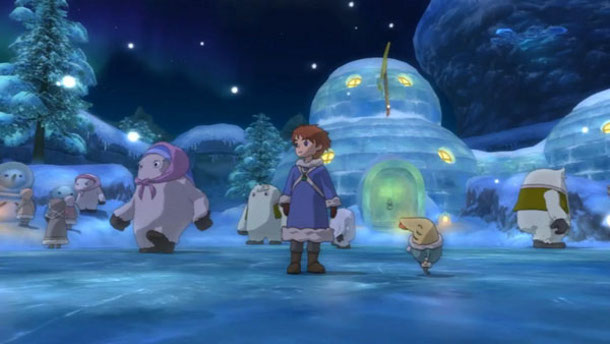
Why didn't any one of the townspeople immediately give them coats upon entering town? A few of them even commented on how they must be cold, seeing how ill-dressed for the weather they are. Why couldn't the coats have happened sooner?
With some of the other outfits, we maybe got a bit overzealous with the side-questing before we encountered the change of costume, but here we canonically have to spend the entire night there before getting the appropriate clothing. And, okay, Oliver was maybe a bit warm in Al Mamoon, and in violation of the local ordinance to not wear a swimsuit in Castaway Cove. But that's not fatal. Here, if this game were a bit more realistic, the entire party died from exposure. And what makes this so ridiculous is that this game DOES do the clothing mechanic. They DO address the fact that they are freezing to death. Why wait so long to give them the coats? What is the point of that?

In other games, the characters never change their outfits, and sometimes they are egregiously over- or under-dressed for the climate of each location they visit (sometimes even both over- AND under-dressed at the same time!). But there, we understand that they only have the one character model, and they are not visibly shivering, and we can have the willful suspension of disbelief that Gibari from Baten Kaitos is just so strong that he can withstand trudging through the snow with his bare chest exposed. We're going to laugh about the severely mismatched clothing and the ridiculous costume designs, but here... this is a mechanic of the game. They change their clothing based on the location. Oliver is visibly shivering to death. You can't just say, oh, you will need these coats or else you will be freezing after the characters have been shivering their booties off for an entire night.
This game keeps falling apart...
We praised how gorgeous this game was, and particularly the first town of Ding Dong Dell...


But actually, Ding Dong Dell is by far the most gorgeous location in the game. Every place you visit from then on is more and more, whatever. This game goes from having such a pretty town as Ding Dong Dell to also having Yule, the most forgettable snow town in history. It's just a few igloos under the aurora, and somehow the developers made it not beautiful or charming at all. Flanoir from Tales of Symphonia had more character, and we fuckin hated that town.
Right outside of Yule, we have to go through an ice dungeon, as mandated by video game law. The ice dungeon of this game really sucks. You have to go through the only available path until Oliver jumps over a bottomless chasm using a precarious pillar, and in getting there, there is now no way back. So the developers implemented a secret passageway that brings you back, which is clearly an afterthought (you have to literally walk through a wall), because they couldn't break it where you teleport out of the dungeon and now you're stuck. So now you go through the secret passage, and the original path turned out to be a waste of time.
Then there's a point where you use Pulse to drop down the icicles so that you can pass over a chasm, and then, to get to a chest behind those icicles that you dropped, you melt them with Fireball, with no concern for how you'll ever get back. If you leave the dungeon now and go back, the icicles will have regrown in the ceiling and you can knock them down again. What the fuck?

Basically, this whole dungeon was extremely poorly designed. Also ugly. It was just ice, nothing more. Not beautiful or anything. Just ice and ice paths. This entire part of the game was terrible.
Also whatever happened to the animated cutscenes? The last one was with Howl -- we mean, Marcassin. That was like, 20 hours ago.
At this point, we've lost hope for this game. But wait, it gets worse.
From Xanadu with Love
First, let's catch you up with the development (or devolution) of the entire mechanic of restoring broken hearts. The first time this was introduced, it was with enthusiasm, and there was an entire section of the game around it, featuring King Tom and his Motorville soulmate, a cat first seen in the opening cutscenes. It takes an entire story arc, and it all made sense.

Then with courage, we had to find Esther's soulmate, which was Myrtle, also a character introduced at the beginning but not super-telegraphed. It's a bit weird that we end up getting courage from her, but, ok, whatever. At least you get to actually meet both soulmates and have a complete storyline, although a bit more shallow than King Tom's. In the course of saving Esther and Myrtle, you also save Myrtle's dad, who was never introduced by the game before, but you can take the town gossip's word that it's weird for him to not have kindness. Way too much tell, and not enough show, but ok, fine.
Restraint is the featured virtue with Swaine, who was suffering from kleptomania. We save him, and he becomes the party's resident... thief. We ask him to steal things despite that being the reason for his descent into madness and possession by nightmares, without any concern for a relapse. Great! Also, we never meet Swaine's soulmate. Given how messed up Swaine was, someone in Motorville must have been fucked up beyond belief, but we never meet that person. We imagine Swaine's soulmate woke up one day suddenly relieved of every ailment, without ever quite figuring out what happened.
Restraint is also introduced with the Cowlipha and Leila. We met Leila in the introduction, but we had no inkling of her crippling cheese addition. What the hell is this, where did it come from, and why?!
We've already cast plenty shade on Marcassin and belief, we don't need to keep shooting at fish in a barrel.
Things decayed at every new virtue added. By when confidence is introduced, the plotline was about Tengri the dragon being unable to fly, because something bad was happening to his soulmate, which he knew about because of his "animal sensitivity". We go to Motorville, and we hear from a dog that Tengri's soulmate is the dog's owner, who is a kid who doesn't want to run anymore, because he's broken his leg and didn't make the track team. And? Oh, says Drippy, he's definitely heartbroken and needs more confidence. Wait, what? First, this is the shallowest storyline ever. Then, how is confidence a problem if his leg is broken? He's not heartbroken, he's legbroken! But we get him confidence, and now, he can do it! His broken leg doesn't matter anymore. He starts running right there! This is a positive and not unhealthy thing! Whatever happened about void of restraint?
We thought this would be the worst, but we were wrong, alas.

Marcassin tells us that we need something something from the city of Xanadu, which unfortunately was utterly destroyed by Shadar five years ago. As soon as we leave Marcassin's palace, not ten feet from the gate, we see a ghost that was never there before, who wears the armor of Xanadu. This ghost tells us where we can find the survivors of the lost city of Xanadu. Well, that problem is solved.
Why couldn't we have met this ghost unrelatedly in Al Mamoon or wherever else much earlier in the game, and now, when we need to find someone from Xanadu, we could have used our brains to think to go back and talk with that strange ghost wearing the strange clothes who maybe mentioned something weird before, instead of learning about the existence of this place that is lost and oh, we would really need to talk from someone from this lost town, but they're all dead, oh no. But then upon walking out the door, there she is. It's the rock from Eternal Sonata all over again.
For that matter, how has nobody mentioned Xanadu before now? This is not some long dead place like the Library of Alexandria, this place was destroyed just five years ago. It sounds like Swaine has been there personally! It was destroyed by Shadar, who is who we're fighting! And some characters have been reluctant to help us in our fight against Shadar because oh no, he's strong and bad. Couldn't someone have mentioned that he's destroyed Xanadu for much less and that is a big part of why they are afraid to help us?

When we arrive to Perdida, the new city of the survivors of Xanadu, we find that the town has this ritual in which the townsfolk are blessed by the queen, which makes people brokenhearted and fearless, and apparently into zombies. Except that everyone seems perfectly fine, if a little cultish. There's a little girl bound for this ritual soon, and Oliver and party, not knowing anything about this culture and what this means and so on, has this really unsavory white-savioring moment of telling the natives (which, by the way, are coded Aztec/Hispanic) that they're wrong, and their culture is wrong, and that this is horrible and they must stop it.
Now that the little girl has heard the keyword "brokenhearted", she suddenly doesn't want to do the ritual anymore. The queen shows up and, since the little girl refuses to accept the blessing, the nightmare that the queen is possessed by attacks. For some reason. And what is her nightmare? Apparently, she's devoid of love. Love???
First of all, what the hell. Why love? Because she's being mean? By doing whatever it took to keep her people alive and not mercilessly slaughtered by Shadar? Because she was possessed? Just because we needed to introduce love, ok?
Before you can even start to think, oh no, where can we even find love, does she have a soulmate or what, sky pirate dude literally drops in from the sky, and says that he loves her, take my love and give it to her. What?

We assumed that love would be left for last because it would get a more complex story arc, probably involving Oliver's mom and so on. Naw, I guess we get, this dude loves the queen, so there's the fucking love, take it, now she's better, done. We don't get introduced to what even is this game's concept of love. And the shallowness of this idea of whatever this sky pirate's relationship is... is horrifying. And so they get married. Or not. Who cares.
Also, after this game initially made the point that you can't take virtues from anyone twice, making it as far to be a WIZARD'S RULE!, ... you take from pirateman twice. Two different virtues, but still. And Drippy makes a point that wow, you're some guy! Why establish a rule of the universe if you're just going to break it whenever you please???
You can make an entire fucking novel about what is love and the power of love and so on! Here it's just, some dude likes the queen. It might as well have been, fetch the milk from Al Mamoon.
Also, now that all the love side-quests are unlocked, we can gather a bit more about what is love according to Ni no Kuni. And it seems they actually mean... horny love. Hard times in Ding Dong Dell, if you catch our drift. Boners! Sex!
Except... why was the queen having a cultish ritual to save the town due to having a void of love? Is the game saying she needed to get laid? Jesus Christ.

Nah, it's just actually, really inconsistent and weird. Later, there's a guy in Al Mamoon who has lost his love for his banana business. Yeah, he needs love for his banana business. Not confidence in his business skills or ambition to keep the business running or enthusiasm in his enterprise or belief in his bananas... no, Drippy tells us, he needs love. So we find a horny guy who has excess horniness -- we're not making this up, he's literally telling us how he's got the hots for Esther, geez! And we tap into this man's disturbing boner for a fourteen-year-old and take this horny love to the banana salesman and give him LOVE FOR BANANAS. HORNY LOVE FROM THE HORNY MAN GIVEN TO THE BANANA MAN. WHO NOW SHOVES BANANAS UP HIS DICKHOLE. WHAT IN THE FUCKING HELL.
You may have noticed that the brokenhearted sidequests are getting more and more absurd. We literally met a woman who was talking about how beautiful the sunset is. Drippy says she has a lot of confidence. Confidence in the fact that this sunset is indeed good??? Don't you mean enthusiasm cause she's just so pumped for the sun? Don't you mean love for the sunset? Belief that the sun will rise again? What in the fucking hell made you think that someone liking the sunset has CONFIDENCE??

You can write the sidequests of this game yourself. Say a random thing, pair it with a random virtue. We like eggs, so we're full of... Belief that we like the eggs. Or maybe, We're sleepy, so we need enthusiasm to stay awake, unless we need restraint to go to sleep. We like cats, so we're full of love for cats. Or maybe courage in the face of claws.
Phil returns

We've been waiting all game for Phil to show up again. The last we saw of him was in the very early cutscene right at the beginning after Oliver's mom died. He was hanging around Oliver's house trying to talk to him, but Oliver wasn't leaving his room, so Phil eventually left. We knew this plotline must be a doozy because he's of course going to feel responsible for what happened. And clearly the game is saving him for later, because we don't see hide nor hair of him in Motorville any of the times we've been there lately. Which, honestly, is a bit strange.
Actually, isn't it kinda sucky of Oliver not even to think of Phil at all during his whole magical adventure? Phil is off who knows where getting lost to guilt and depression, and knowing that Oliver hasn't even left his room for days... Phil must be beating himself up thinking it is all his fault... but Oliver's just off having a grand adventure! And forgetting that Phil even exists, except to have one flashback where he remembers how Phil used to make fun of him for having a doll.

Oliver and company then meet a little mouse in Ding Dong Dell that suddenly exists. The characters talk about this mouse as if he has always existed, but we could never see him before. This mouse (somehow) pickpocketed the holy wood from us, which is critical for us to forge the McGuffin trumpet known as The Clarion, and now we need to find the mouse to recover the wood.
The game tells us to ask around, so we tried to talk to random NPCs and ask them, "Hey, have you seen my wood? I mean, my holy wood? I mean, it's a sacred log, I mean, oh, god..." but for some reason the developers didn't put any actual dialogue for us to ask the townsfolk about our missing ...item. Even though we are supposedly supposed to be asking around, only the relevant person has any information, and that's the crow on the complete other side of town inside a building. Nobody any closer to the event saw the pickpocketting occur, nor saw a little mouse run by with our holy wood held up in the air. We can kinda guess why the developers didn't put in this dialogue, but it's still cheap. Then again, if Rosy can write a whole story about attractive sorcerers grasping onto staves, this game can figure out how to have the characters ask around for help finding their holy wood.

But anyway, the crow tells us that there is a mouse that sold him the wood, but we need to get proof that the wood was indeed stolen. Now the mouse suddenly exists in town.
We want to point out that, except for King Hickory, there hasn't been any mice characters in the game before now. And King Hickory was a giant anthropomorphic mouse. But this new character is a tiny, animal-mouse that wears glasses but speaks in human-language (we don't need to use our spell for talking to animals with it). What is going on here???

By the way, in this game, there are: humans, anthropomorphic cat-people, anthropomorphic cat-monsters, anthropomorphic mouse-people, sentient mice, dogs that speak dog language, dogs that can only bark, barely-cow-like cow people (well, one), anthropomorphic bird-people, birds, bird-monsters (of varying degrees of anthropomorphism), crabs, yetis, sentient robot-monsters, fairy-monsters, fairies, dragons, skeleton-people, and ghosts. What is the logic of this world? How is this not a prejudices nightmare? While we like the variety of this game, it is starting to become inconsistent with itself. Maybe it shouldn't have both the anthropomorphic cat-people and the anthropomorphic cat-monsters. And if there are dogs, it's starting to have the Donald Duck problem of anthropomorphic animal people keeping less anthropomorphic animals as pets and that's weeeird.
Like, we met an anthropomorphic cat person named Purrofessor Tabitha, who uses the expression: "not enough room to swing a cat". What the fuck is wrong with her?!

Anyway, we talk to this mouse, and because it starts taunting Oliver for sleeping with a stuffed toy, Oliver realizes that this mouse is Phil's soulmate. Why does the mouse, who never met Oliver before, know to taunt Oliver about the exact same thing that Phil would taunt him about? Okay, they are soulmates, but the game has been making the point that soulmates are not the same person, they are in fact very different individuals who just so happen to either look alike or have some other similarity, and to be linked, but otherwise be very different individuals. So, how can this be?
After a very drawn out exchange of confirming that this mouse is indeed Phil's soulmate, and that Phil is indeed Oliver's friend even though... the game hasn't given us the slightest piece of evidence that Phil is indeed a friend to Oliver... or, vice versa, honestly... all Phil has done is getting Oliver in trouble, letting him be the first test pilot of the completely untested car he built (even admitting that if it breaks, it will be with Oliver inside, and not himself), and taunting Oliver to tears, presumably more than once. The only way Oliver recognizes Phil's soulmate is because of this taunting. Yikes! With friends like these, who needs enemies? Maybe this is why Oliver thinks Esther, Swaine, and Drippy are such wonderful pals, even though they (and especially Drippy) are pretty heavy with the verbal abuse... but it's not as bad as Phil, maybe? None of them have made him cry, yet, we guess. Just, yikes.
Yes, sometimes your friends will upset you, and they will still be your friends. But this game hasn't shown one thing to establish the good parts of Phil and Oliver's friendship at all.
Anyway, we go back to Motorville to see what's been happening to Phil. And there Phil is, conveniently standing in the middle of Oliver's front yard. We didn't need to look for him at all. There was no quest to find him, or anything like that. Just, there he is. And we go talk with him, and he's says that it's all his fault, and Drippy tells us he's possessed by a Nightmare, and then, boom, we fight the nightmare.
That's it.
The previous two virtues have been revealed pretty lamely, which sucks, but we thought maybe it was a bit of a lull before the bigger deal story point, like whatever they were going to do with Phil. We were wrong. They did nothing with Phil.

We defeat the Nightmare, and Phil says that it's all his fault that Oliver's mom died, and it should have been him in the car, so that then Oliver's mom wouldn't have needed to save Oliver. Dude, she would have jumped in the lake to save you too, you silly. Now Phil says he has to give up his dream of building a car, because what if he makes another car, and someone else dies. But Oliver's mom died not so much because of the car itself, but because of jumping in the lake. And if you want to back it up more, it was because Phil insisted that they sneak out for this test run next to a lake all alone in the middle of the night. So, if anything, he should be blaming himself for that. Not that grief and guilt need to make sense, but just sayin'.
But yeah, so now Phil says that his dreams of building a car are dead, because Oliver's mom has died, tangentially due to the car he made.
And Drippy concludes that Phil has lost his ambition.
That's the problem here. That Phil has given up on his dreams. Not because of his unnecessary and excessive guilt over something that isn't really anyone's fault. Nope, it's because of his lack of ambition.
Oliver gives an impassioned speech about how you are never allowed to give up on your dreams, and you must believe in your dreams, and you must pursue your dreams to the bitter end. And so Oliver is now brimming with ambition. So he can Take Heart from himself and give it to Phil. How conveniently close by. We don't even have to go get it from the mouse or anything. Oliver has it right there.
If a wizard giving their own heart to others is even a thing that's possible, then why isn't wizardry more about summoning powerful emotions to give to others?

How exactly is ambition different from confidence or enthusiasm or love for your banana business?
Anyway, Phil is cured, and he says he will go to college to learn how to make safe cars that won't kill people. He is possibly the inventor of the airbag. Denise still finds this a little bit cute, even if this still is broken.
We go back to Ding Dong Dell, and the mouse is no longer a pickpocket. He resolves the situation with the holy wood, and he admits that he stole it to attempt to fund his dream-project.
If the mouse was robbing people to get funds for his project, it sounds like he had too much ambition, not too little. They frame this sudden kleptomania as being due to Phil's brokenheartedness, but isn't this backwards? Isn't he just void of restraint, like Swaine?
And what was the mouse's dream project? To build what sounds like a bootleg racing broom straight out of the world of Harry Potter. Haha, he's building a broom, just like Phil building a car, haha. While it has been implied that wizards can ride brooms in this world, this hasn't actually come up once. It's in the first game that never made it out of Japan, but not here. We haven't seen one person riding on a broom. And we don't ride a broom either. We walk, or levitate, or ride a boat, or ride a dragon, or flat-out teleport. But we don't ride a broom.
The role of magic
In the beginning, we thought this game was going to have more of what it means to be a wizard in this world, and more of an explanation of the workings of magic. We're given a magical book in the beginning and we're told to read it and it contains all sorts of tenets of magic and things that a wizard should strive for... and we thought, cool, so this is going to be relevant, since it's right here in the book, right?

This turns out to be essentially flavor text, and the book is promptly forgotten. To make matters worse, we meet the Great Sages, and none of them have anything of importance to teach to Oliver. They hand him a few spells, and that's it. Nothing about their personal journey, what magic means for them, and so on. Oliver even travels with the daughter and the son of two separate Great Sages, and neither of them, who should be in some way knowledgeable in magic, have anything to tell to Oliver. Except for the nursery rhyme, which is god.
The characters are talking about reforging the Clarion of old, and Esther goes all, oh, my daddy taught me a nursery rhyme. She recites it and it reveals the steps for rebuilding the Clarion. Esther, your father is a Great Sage, you think he just told you this nursery rhyme that has no meaning, you don't understand this is plot-related? And then when we're rebuilding the Clarion, everyone in the world recognizes the magical wood and what it's used for, but not Esther.
Most games involving magic in some way don't actually explain what magic means to the characters that work with it beyond some handwave of "I studied the books, and my mom was a wizard too". This is a common thing, but the particular grievance with Ni no Kuni is, once again, that it almost went there. It had all of this worldbuilding in the book that then amounted to nothing.
Never we meet another random wizard. They seem to have died out, except everyone also has spells to give you. And there's still Great Sages running around and not spreading magic to anyone, somehow. You'd imagine there would be more than exactly one random player-controlled wizard in the world. How is magic simultaneously said to be something that Shadar killed off, but everyone that Oliver does magic on is fine and dandy with it?
The Clarion

Anyway, now that we have the holy wood, we need to carve it into a flute. So that we can then blow the holy wood. Sorry, we couldn't help it. Anyway, this carving needs to be done by Marcassin and Swaine together, as each knows one part of the process. When Marcassin and Swaine are talking about their part in crafting the Clarion, Esther does this really awkward thing of, "oh Swaine, why didn't you tell us that you happen to know all of these magical princely things, and isn't it convenient that you happen to know them!" And Swaine says, "Yes. I am Gascon. It is the truth. Now, let's move on."
We already dealt with this plotpoint - or rather, didn't deal with this plotpoint. But confirming now that Swaine is Gascon makes absolutely no difference because it's not like this is addressed. If this scene was cut, nothing would have been different. Except less awkwardness. Why make the vow with Oliver that we're not going to talk about this out of respect for Swaine if you're going to be a jerk and passive-aggressively bring it up anyway? Once again, they did something, then ruined it.
Anyway, the Clarion is remade. We go toot toot and the fog is gone from the swamps. That's it. That's all this was for. This magical legendary HM. Defog.

So now we can go fight Shadar!